 |
 The
fancier the dinner, the more attractive the person paying for it. For fine
dining, click here. The
fancier the dinner, the more attractive the person paying for it. For fine
dining, click here.
|
 |
|
 |
|
|
|
|
|

 |
 |
 |
 | ||
| HOME Site index 

 |
|
|
|
Friday, March 01, 2002 - 12:00
a.m. Pacific Still in the pink: Yes, boomer girls play with Barbies — expensive ones By Pam Sitt
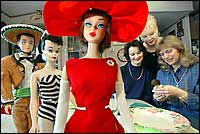
Barbie Ponytail #3 — yes, that is her Mattel-given name — looks nothing like the Barbies you'll find lining the shelves of your average toy store. Circa 1960, this doll has milky-white skin, raven tresses and heavy-lidded, almond-shaped blue eyes. She wears tiny pearl earrings and a zebra-print one-piece swimsuit. Kristie Ibarra, of Algona, spotted Barbie Ponytail #3 — valued at around $500 — at a thrift store five years ago. It's now one of her prized possessions. These are the kind of stories that are told at a Barbie lunch, which happen monthly at Ibarra's house or at one of her girlfriends' houses (except the time when it was at the Olive Garden in Tacoma. Turns out the waitress was interested in Barbies, too — lunch turned into a three-hour affair.) "We basically sit around like little kids," said Ibarra, 42, "and show-and-tell our Barbies to each other." As grown-up lovers of Barbie, Ibarra and friends Debbie Marsteller, 48, of Steilacoom, and Debi Tye, 46, of Tacoma, would probably argue with numbers that indicate that Barbie may be past her peak. The world's best-selling doll turns 43 this year, and if sales are any indication, Barbie — whose worldwide sales peaked in 1999 — is officially over the hill. Sure, Barbie and her friends still rake in a cool $1.5 billion in annual sales for Mattel. But the vintage dolls that Ibarra collects — a top doll might have gone for $8,000 five years ago — are experiencing a drop in value, a symptom of a larger downturn in the $10 billion collectibles market as the economy continues its downward spiral. But there are still big girls — and boys, too, but that's another story — who like to play with dolls, and three of them have gathered for what they call a "Barbie lunch" at Ibarra's house on a Wednesday afternoon. The three friends met at one doll show or another, around the time Ibarra approached Marsteller, who restores dolls, with Barbie Ponytail #3. "I don't really concern myself with the value of my collection because (the dolls are) like part of the family," Ibarra says. "If you're going to collect anything, you should collect it because you enjoy it and not because of what value you can get out of it."
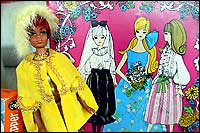
Among them, the three women have around 250 vintage Barbies — "vintage" meaning at least 25 years old. The dolls have names like Sunset Malibu Barbie, Dramatic New Living Barbie and Talking Barbie. (What did the now-mute Talking Barbie say? " 'Let's go to the mall,' or something," Marsteller says.) They find them in thrift stores, at garage sales, at doll shows and on the Internet. (Doll collecting is second only to stamp collecting as the most popular collecting hobby in America, and when you're at a Barbie lunch, you believe it.) A mint-condition, in-the-box Barbie Ponytail #1, the first model ever made in 1959 — none of these women have one — once sold for a record $10,000. Barbie's clothes can cost anywhere from $60 to $1,000 per vintage outfit. "I don't buy myself clothes anymore," Tye says, without a hint of wistfulness. At this Barbie lunch, the women trade Barbie stories over lasagna and peach pie while Barbie and Ken in Mexico look on. Marsteller recalls the time she found a bargain on vintage outfits, a steal at $4 or $5 a pop. Tye confesses, with much chagrin, that she sold all of her vintage Barbies — worth thousands today — for $20 when she was 13 years old. (She wanted a new dress for a party.) The women talk about daughters who have outgrown Barbies and husbands who tolerate them. "If I get really stressed out, my husband will say, 'Go play with your dolls,' " Ibarra says with a laugh. But for these women, the dolls signify more than just casual play — they create a bond not unlike the one children form with one another while playing with their favorite toys. "It's a middle-age, baby-boomer thing," explains Marsteller. "It's a way for women to connect to one another. It doesn't matter what your husband does or how many kids you have. ... We all collect dolls." Pam Sitt can be reached at 206-464-2376 or psitt@seattletimes.com.
|
|
|
|

| ||||||||||||||||||||||||||||||||||||||
|
|
|
|
|
|
|
|
| ||||||||||||||||||||||||||||||||||||||


|
| ||||
|
SeattleAreaHomes.com Search For Homes. Free Professional Assistance Search For Homes. Free Professional Assistance
|
|
|
 |
|
|
|
|
|
|
| ||||

 Back to
top
Back to
top